10 Marketing Skills That Get You Into FMCG After an MBA
By Shweta Arora · Published 15 August 2026 · 4 min read · Master in Business Administration (MBA)
FMCG marketing roles reward a set of skills you can start building well before you reach campus. The big ones are consumer insight, market research, data analytics, telling a story through slides plus building relationships with distributors on the ground. Get a head start on these and your summer placement season gets a lot easier.
 Preparing for CAT 2026? Solve 1000+ Free Questions on Percentyl
FMCG marketing roles reward a set of skills you can start building well before you reach campus. The big ones are consumer insight, market research, data analytics, telling a story through slides plus building relationships with distributors on the ground. Get a head start on these and your summer placement season gets a lot easier.
I put this list together from my own summer internship at Mondelez plus a long chat with a marketing professor at IIM Ahmedabad. It is aimed at anyone drawn to the sales and marketing roles that FMCG companies offer after an MBA, though the skills help any marketer.
At a Glance
Skill | Why it matters |
|---|---|
Consumer insight | FMCGs hire people who think like their customers |
Market research | Finding and defining the real problem |
Data analytics | Turning research into decisions |
Storytelling in slides | Selling an idea to leadership |
Distributor relationships | Sales runs on the ground network |
Brand management | Owning how a brand is seen |
Communication | Aligning teams and partners |
Negotiation | Getting deals done with trade partners |
Financial sense | Reading a brand's P&L |
Digital marketing | Reaching consumers online |
1. Strategic consumer insight
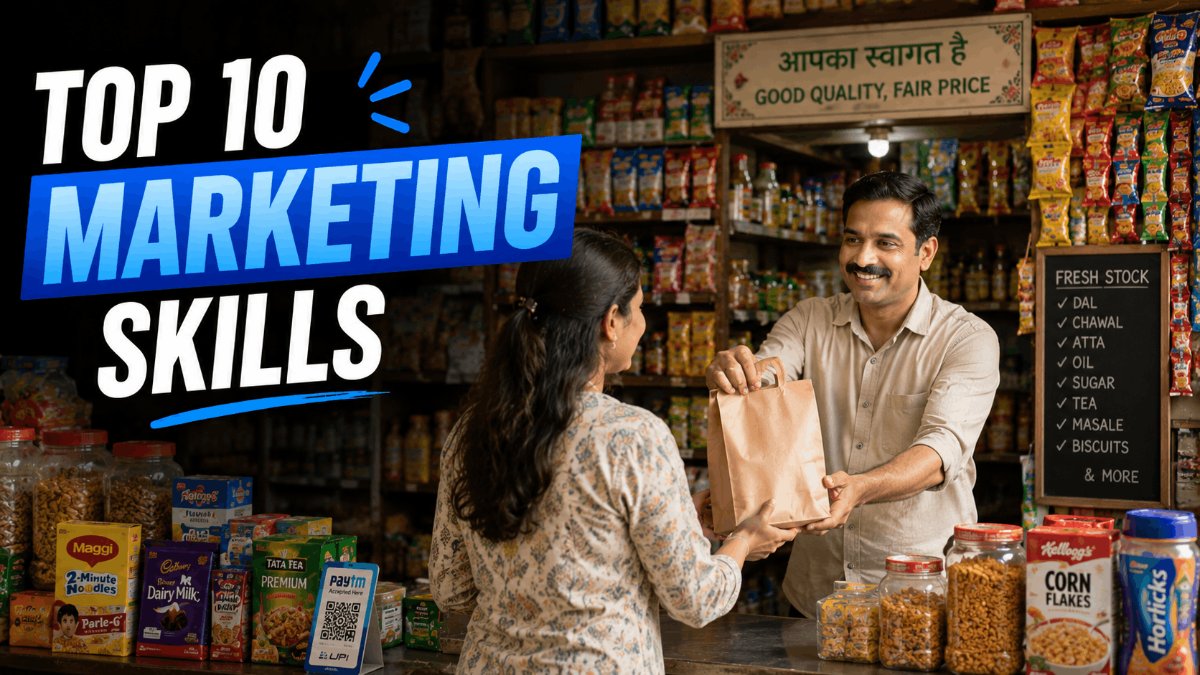
Most FMCGs look for people who are consumer-centric. Picking up insight is a skill you build by staying curious. Let me share the first real consumer insight I ever caught. I was helping at my uncle's general store during Diwali plus put up a hand-written 10% OFF sign next to some decoration pieces.
Within minutes a customer rushed in, picked up a piece plus asked if it cost 10 rupees. She was not the only one. The store was in a semi-rural area where most people read Hindi or Punjabi, so 10% OFF did not read as a discount in their minds. They saw the number first plus filled the gap themselves. That day taught me to think like the consumer. It also taught me that numbers grab attention while the mind completes the story. To build this, read on psychology, pricing plus behaviour. Good starting books are The Branded Mind, Thinking, Fast and Slow plus Buyology.
2. Market research
You will not find a marketer who cannot run market research. It means gathering information about consumers, using it to spot a problem plus recommending a fix. It comes in two types. Exploratory research is qualitative and helps you find and define the problem, through in-depth interviews, focus groups plus reading up on what exists. Conclusive research is quantitative and tests whether your idea holds, through questionnaires, simulations plus experiments. At IIM-A the signature first-year course for this is Business Research Methods.
3. Data analytics
Research plus analytics go hand in hand, so pair one with the other. Analytics is how you turn the numbers from research into a decision. A well-regarded starting point is the Customer Analytics course from Wharton. This skill helps in FMCG roles plus during the two years of your MBA. Statistics is one of the best things to pick up before you start.
4. Storytelling in slides
Marketing does not live in slides the way consulting does, yet you still present to leadership often. When you do, a clear plus vibrant deck carries your idea. Marketing presentations are less formal than consulting ones, so let them be lively. The decks that win case competitions are a good model to learn from.
5. Distributor and field relationships
I cannot stress this one enough. Your first stint in FMCG is often a field sales project where you deal with retailers, wholesalers plus distributors. Hearing their concerns, meeting them in person plus solving their problems fast is a real skill. It is learned mostly on the ground, but you can start small by getting comfortable talking to the vendors around you, from the shop next door to an auto driver.
The other five, in short
Brand management is owning how a brand looks, sounds plus feels to a customer over time. Communication keeps teams plus trade partners moving in the same direction. Negotiation gets deals done with distributors and vendors without burning the relationship. A basic grip on a brand's profit and loss statement helps you argue for budgets plus judge what is working. Digital marketing rounds it off, since a growing share of FMCG spend now goes online. You do not need all ten before campus. Build two or three deeply plus you will stand out.
Frequently Asked Questions
Which marketing skill should I build first?
Consumer insight. FMCG companies hire people who think like their customers. It is a habit you build by staying curious and observant, not a course you finish.
Do I need a marketing background for FMCG roles?
No. These skills can be learned by anyone willing to practise them. Market research, analytics plus consumer insight are all teachable. Your MBA courses cover the foundations.
What free or low-cost resources help?
For consumer insight, read The Branded Mind, Thinking, Fast and Slow plus Buyology. For analytics, the Wharton Customer Analytics course is a strong start.
How important is field and distributor experience?
Very. Early FMCG marketing roles often begin with a field sales project, so being comfortable dealing with retailers plus distributors is a real advantage.
Frequently Asked Questions
Which marketing skill should I build first?
Consumer insight. FMCG companies hire people who think like their customers. It is a habit you build by staying curious and observant, not a course you finish.
Do I need a marketing background for FMCG roles?
No. These skills can be learned by anyone willing to practise them. Market research, analytics plus consumer insight are all teachable. Your MBA courses cover the foundations.
What free or low-cost resources help?
For consumer insight, read The Branded Mind, Thinking, Fast and Slow plus Buyology. For analytics, the Wharton Customer Analytics course is a strong start.
How important is field and distributor experience?
Very. Early FMCG marketing roles often begin with a field sales project, so being comfortable dealing with retailers plus distributors is a real advantage.