Algebra Topics for CAT: What Comes and What to Revise
By Shweta Arora · Published 16 November 2026 · 8 min read · Exam Preparation
Six algebra topics made up about a third of CAT Quant from 2020 to 2025. Here is how often each appeared and which to revise first before 29 November.
Preparing for CAT 2026? Solve 1000+ Free Questions on Percentyl
Algebra in CAT covers six topics: linear and quadratic equations, progressions, logarithms, functions, inequalities, and maxima and minima. Across the 18 CAT papers from 2020 to 2025, these topics made up 134 of 408 Quant questions, roughly one in three. Every paper had between five and nine algebra questions.
CAT 2026 is on Sunday, 29 November, and the Quant section gets exactly 40 minutes. With about two weeks left, the useful question is no longer what algebra is. It is which algebra topics to revise first, and which ones you can safely give less time.
CAT algebra at a glance
| Detail | Value |
|---|---|
| CAT 2026 test day | Sunday, 29 November 2026, in three sessions |
| Quant section | Section III, Quantitative Ability, 40 minutes, no switching between sections |
| Calculator | Basic on-screen calculator; keyboard operation is disabled |
| Algebra topics | Equations, progressions, logarithms, functions, inequalities, maxima and minima |
| Algebra share, CAT 2020 to 2025 | 134 of 408 Quant questions across 18 papers |
| Most frequent algebra topic | Linear and quadratic equations: 58 questions, in all 18 papers |
Source: iimcat.ac.in, read 13 November 2026. Past-paper counts are from the 18 CAT previous year papers, 2020 to 2025.
Quick tips
- Start with linear and quadratic equations: they appeared in all 18 CAT papers from 2020 to 2025.
- Solve past CAT algebra questions topic by topic, and redo every one you got wrong or took over three minutes on.
- Substitute the answer options back into the equation when the algebra gets long; it is often quicker.
- Keep one page of identities and log rules, and read it the day before 29 November.
- Give each long algebra question one minute to decide: attempt now, return later, or leave it.
Which algebra topics are in the CAT syllabus?
CAT algebra is six topics, and two of them carry most of the weight. The official CAT documents name the section, Quantitative Ability, but not its chapters, so the working list comes from the papers themselves. Here is what each topic usually tests.
- Linear and quadratic equations. Turning a word problem into equations, roots and their sum and product, the nature of roots, polynomials and integer solutions.
- Progressions. Arithmetic and geometric progressions, the nth term, the sum of n terms, and series that collapse when you write out a few terms.
- Logarithms. The log rules, change of base, equations that mix logs and powers, and the conditions under which a log is defined.
- Functions. Function definitions, composition, graphs and their shifts, modulus and greatest-integer functions, and functional equations.
- Inequalities. Ranges of values, modulus inequalities, and the AM-GM inequality.
- Maxima and minima. The largest or smallest value of an expression, usually through AM-GM or the vertex of a quadratic.
Polynomials and surds sit inside the equations questions rather than on their own. If a coaching list shows more than six algebra chapters, it has usually split these six more finely.
How many algebra questions come in CAT?
Expect roughly seven or eight algebra questions in a CAT Quant section, based on past papers. In the 18 slots of CAT 2020 to CAT 2025, algebra accounted for 134 of 408 Quant questions. No single paper had fewer than five or more than nine.
The split inside algebra is uneven. Linear and quadratic equations alone produced 58 questions and appeared in all 18 papers. Progressions came next with 25 questions in 17 papers, then logarithms with 18 in 15 papers. Functions had 13 questions in 13 papers. Inequalities and maxima and minima had 10 questions each, in 9 and 7 papers.
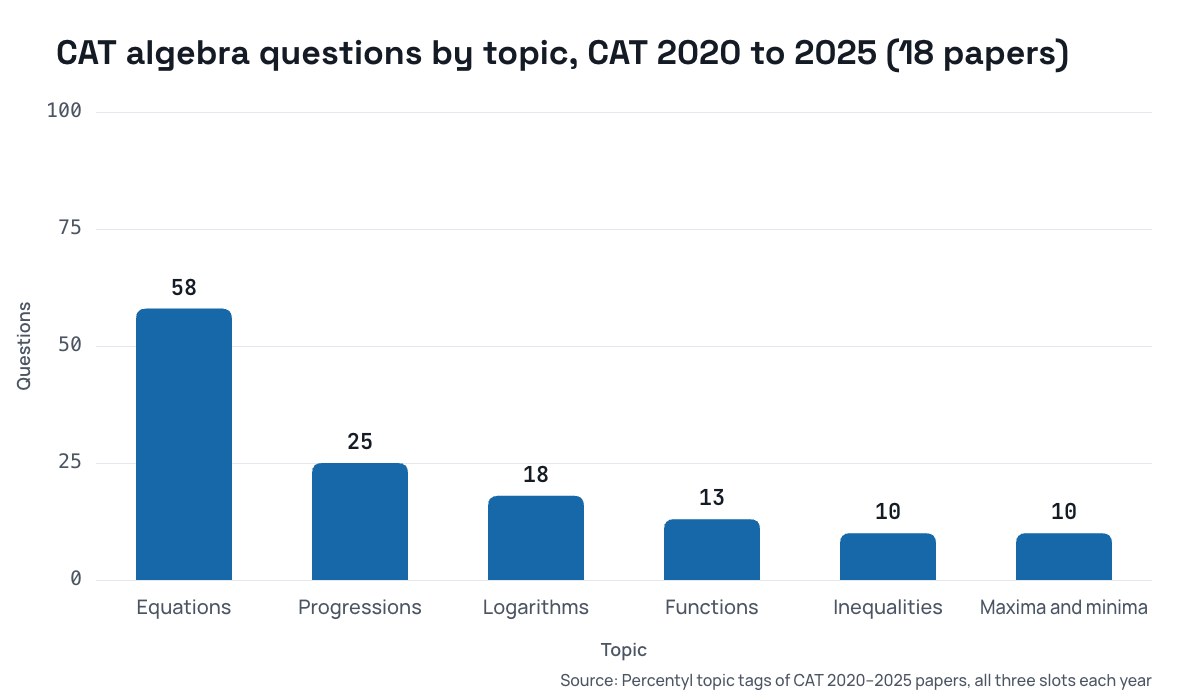
Source: Percentyl topic tags of CAT 2020–2025 papers, all three slots each year
Two things follow. First, equations are not optional: they have turned up in every slot for six years. Second, the bottom three topics together gave fewer questions than equations alone, so they deserve revision time in proportion, not equal time.
Which algebra topics should you revise first?
Revise in order of how often a topic appears, and stop each topic once past questions feel routine. That order is:
- Linear and quadratic equations. Redo past CAT questions on framing equations and on roots. Check that you can find the sum and product of roots without solving the equation.
- Progressions. Make sure the nth-term and sum formulas for both progressions come to you without thinking. Practise questions where you must find the number of terms.
- Logarithms. Rewrite the five or six log rules from memory. Most CAT log questions fall once the expression is converted to a single base.
- Functions. Sketch modulus and greatest-integer graphs by hand. Many function questions become simple once you can see the graph.
- Inequalities and maxima and minima. Revise AM-GM together for both, since the same idea solves many questions in each.
If time runs short, protect the first three. Together they produced 101 of the 134 algebra questions in the last six years of papers.
How should you revise algebra in the last two weeks before CAT?
Use past papers, not new material. At this stage a new trick costs more than it saves. A simple routine for the time left:
- Days 1 to 4. Solve the equations and progressions questions from past CAT papers, topic by topic. Mark every question you got wrong or took more than three minutes on.
- Days 5 to 8. Do the same for logarithms and functions, then inequalities and maxima and minima.
- Days 9 to 12. Redo only the marked questions, without looking at the solutions first. Any you still miss go onto a single page of notes.
- Days 13 to 15. Take one or two timed 40-minute Quant sectionals. Practise skipping: decide within a minute whether an algebra question is one to attempt now, later or not at all.
- The day before. Read your page of notes and your formula sheet. Do not start anything new.
Keep the mix with arithmetic. Algebra is about a third of past Quant sections, so it should be about a third of your Quant revision, not all of it.
Can you skip algebra in CAT?
No. Leaving out algebra means giving up about a third of the Quant section before the test begins. Skipping individual questions is a different matter and is good practice. A long functions question or a tricky inequality is often the right one to leave, especially if an equations question sits two places later.
The section is 40 minutes and you cannot move to another section while it runs. So a question you skip can only be revisited inside that window. Read every algebra question once, attempt the clear ones, and return to the rest only if time is left.
Does the CAT calculator help with algebra?
Only a little. The CAT calculator is a basic one. It handles percentages, square roots and reciprocals, and has memory keys, but it works with the mouse only because keyboard operation is disabled. It will not solve an equation or work with variables.
Where it helps is checking. Once you have narrowed a quadratic to two candidate roots, substituting an answer option is quicker on the calculator than by hand for awkward decimals. For most algebra questions, though, a clean line of working on the rough sheet is faster than clicking through numbers.
What to do next
Start with the questions that have already been asked. Open the CAT previous year papers and solve the algebra questions slot by slot, or use the topic filters on Practice questions to pull equations, progressions or logarithms on their own. Keep the Formula book open for identities and log rules while you revise, and close it before you take your Sectional tests so you know what you actually remember. For a short daily habit until 29 November, the Daily Quant set keeps your hand in without eating into your mock schedule.
Frequently Asked Questions
What are the algebra topics for CAT?
CAT algebra covers linear and quadratic equations, progressions, logarithms, functions, inequalities, and maxima and minima. Polynomials and surds usually appear inside equations questions. The official CAT documents name the Quantitative Ability section but do not publish a chapter list, so this list comes from past papers.
How many algebra questions come in CAT Quant?
Across the 18 CAT papers from 2020 to 2025, algebra made up 134 of 408 Quant questions. Each paper had between five and nine algebra questions, so about seven or eight is typical.
Which algebra topic is most important for CAT?
Linear and quadratic equations. It produced 58 questions between CAT 2020 and CAT 2025 and appeared in all 18 papers. Progressions and logarithms come next.
Is algebra harder than arithmetic in CAT?
Algebra questions often take longer to set up, but many fall quickly once written as an equation or checked with the answer options. Treat each question on its merits: attempt the clear ones first and leave long ones for the end of the 40-minute section.
Can I use the CAT calculator for algebra questions?
Only for arithmetic. The CAT on-screen calculator handles basic operations, percentages, square roots and reciprocals, and keyboard operation is disabled. It is useful for checking an answer option, not for solving an equation.