CAT 2026 Quant Formulas: Chapter List and Formula Book
By Shweta Arora · Published 18 July 2026 · 4 min read · Common Admission Test
The chapter-wise formulas worth memorising, plus the formula-book habit that makes weekend revision quick.
 Preparing for CAT 2026? Solve 1000+ Free Questions on Percentyl
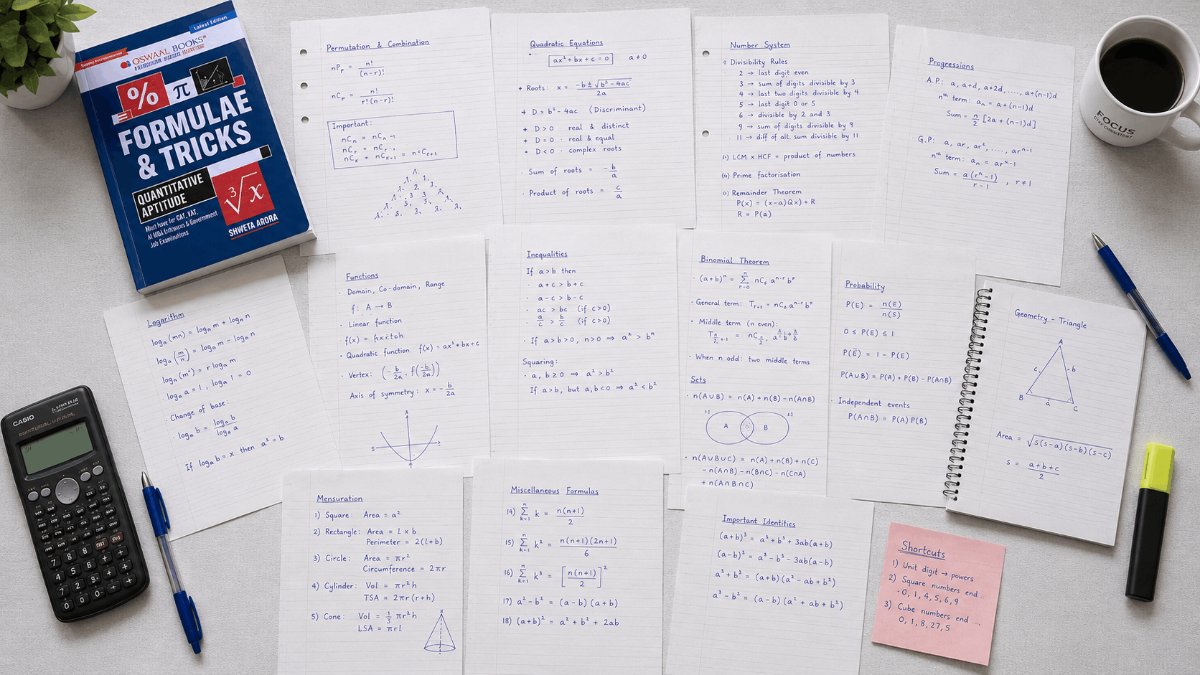
The fastest way to revise CAT Quant is a formula book you build yourself. A few pages per chapter, written in your own hand and updated every time a mock teaches you something new.
Below is the chapter-wise list of formulas worth capturing and the way someone can build their own while preparing for CAT. You will also get to know how to use it, so revision takes minutes instead of hours.
At a Glance
Item | Detail |
|---|---|
QA section (CAT 2026) | 22 questions in 40 minutes |
Marking | +3 correct, minus 1 for a wrong MCQ; no negative on TITA |
CAT 2026 date | Sunday, 29 November 2026 (expected) |
What to build | One formula book, a few pages per chapter |
Best use | Weekend revision and mock analysis |
Why a formula book beats re-reading notes
Notes are long. A formula book is short. That is the point.
When you condense a chapter into a handful of formulas, identities and shortcuts that show up in the exam, you can revise all of Quant in a weekend. Re-reading a textbook before a mock does not work. Flipping through tens of tight pages does.
Writing each formula yourself matters too. We remember what we write far better than what we read, so the act of building the book is half the revision.
The chapters to capture
CAT Quant draws from a fixed set of chapters. Keep a labelled section for each one and leave a few blank pages after every chapter, because new shortcuts turn up during mock analysis right till the end.
Chapter | What to note down |
|---|---|
Number System | Divisibility rules, factors and their count, remainders, cyclicity of the units digit, HCF and LCM |
Arithmetic | Percentages, profit and loss, ratios, averages, mixtures, time and work, time, speed and distance |
Algebra | Linear and quadratic equations, inequalities, functions, logarithms, progressions |
Geometry and Mensuration | Triangle and circle properties, coordinate geometry, areas and volumes of solids |
Modern Maths | Permutations and combinations, probability, set theory |
How to build your formula book
Start on day one and never stop
Do not wait until you finish a chapter to record its formulas. Note them from the moment you start the basics, right through to your last mock. A formula can surface at any stage, so the book grows with you.
Use a simple colour code
Used two highlighters, one for standard formulas and one for tricks or traps you keep getting wrong. A glance at the colours tells you where your weak spots are. Pick any system you like, then stay consistent.
Add a Golden Book for mental math
Alongside formulas, keep a reference sheet of tables up to 30, squares up to 30, cubes up to 20 and common fraction-to-percentage conversions. This is your Golden Book. It speeds up the arithmetic that quietly eats time in both Quant and DILR.
Ready-Made Formula Book
If you feel making a formula book of your own is tedious, you can also refer to a ready-made paperback formula book. I have authored one such book that is readily available on Amazon and contains only 150 pages to offer a quick glimpse and walkthrough of all Quant formulas and tricks for CAT 2026.
How to use it once it is built
Revise the whole book every weekend. It takes under an hour once it is tight. It keeps every formula on call.
After each mock, open the book during analysis. Every question you got wrong for a silly reason points to a formula or trick that belongs on the page. Over a few months, the book becomes a record of your own mistakes, which is exactly what you want to revise the night before CAT.
Treat any downloaded formula list, including mine, as a checklist to compare against, not a substitute. Build yours first, then see what you missed.
Frequently Asked Questions
Should I build my own formula book or download one?
Build your own. The writing is what fixes the formulas in memory. Use a ready-made list only to check for gaps once yours is done.
When should I start making it?
From the first chapter you study. Keep adding to it through your mocks, because the most useful entries come from mistakes you make late in prep.
How many formulas do I need for CAT Quant?
Fewer than you think. A few tight pages per chapter cover almost everything CAT tests. The exam rewards application over memory, so do not hoard formulas you never use.
Are formulas enough to clear the QA cutoff?
No. Formulas are the base. The score comes from practice, mock analysis and smart selection of which questions to attempt in the 40 minutes you get.
Frequently Asked Questions
Should I build my own formula book or download one?
Build your own. The writing is what fixes the formulas in memory. Use a ready-made list only to check for gaps once yours is done.
When should I start making it?
From the first chapter you study. Keep adding to it through your mocks, because the most useful entries come from mistakes you make late in prep.
How many formulas do I need for CAT Quant?
Fewer than you think. A few tight pages per chapter cover almost everything CAT tests. The exam rewards application over memory, so do not hoard formulas you never use.
Are formulas enough to clear the QA cutoff?
No. Formulas are the base. The score comes from practice, mock analysis and smart selection of which questions to attempt in the 40 minutes you get.