FMS Delhi ROI: Rs 2.4 Lakh Fees, 32 LPA Average Package
By Shweta Arora · Published 5 September 2026 · 7 min read · Master in Business Administration (MBA)
FMS Delhi charges Rs 2,43,272 for the full two-year MBA. Its 2024-26 batch placed at an average of 32.27 lakh, a median of 29.59 lakh and a highest package of 1.1 crore, with 119 recruiters on campus. That is roughly 13 times the course fee in first-year salary alone. No other top Indian B-school is close on that ratio.
 Preparing for CAT 2026? Solve 1000+ Free Questions on Percentyl
FMS Delhi charges Rs 2,43,272 for the full two-year MBA. Its 2024-26 batch placed at an average of 32.27 lakh, a median of 29.59 lakh and a highest package of 1.1 crore, with 119 recruiters on campus. That is roughly 13 times the course fee in first-year salary alone. No other top Indian B-school is close on that ratio.
The reason the gap is so wide has little to do with FMS placing better than the IIMs. It places at about the same level. The difference sits entirely on the cost side, because FMS is a department of Delhi University and charges public university fees while recruiting in the same rooms as the IIMs. That single fact drives the ROI number. It also explains the trade-offs, which matter more than the ratio does.
FMS Delhi at a glance
Detail | FMS Delhi |
|---|---|
Total MBA fee | Rs 2,43,272 for two years, at Rs 60,818 a semester, for the 2026-28 batch |
Average CTC | Rs 32.27 lakh for the 2024-26 batch, up from 30.1 lakh the year before |
Median CTC | Rs 29.59 lakh |
Highest CTC | Rs 1.1 crore |
Top decile average | Rs 60.67 lakh |
Recruiters | 119, of which 68 were new or returning |
Batch size | About 307 |
Summer internship stipend | Rs 3.42 lakh average for two months, 5 lakh highest |
Entrance exam | CAT, with no officially published percentile cut-off |
Source: FMS Delhi 2026 final placement reporting and the published 2026-28 fee structure.
The ratio, against the schools you would compare it with
Divide the average package by the total course fee and the picture is stark.
School | Total fee | Average CTC | Package per rupee of fee |
|---|---|---|---|
FMS Delhi | Rs 2.43 lakh | Rs 32.27 lakh | About 13.3 times |
JBIMS Mumbai | Rs 8.34 lakh | Rs 26.48 lakh | About 3.2 times |
IIM Bangalore | Rs 26.00 lakh | Rs 34.88 lakh | About 1.7 times |
IIM Lucknow | Rs 20.75 lakh | Rs 32.30 lakh | About 1.6 times |
IIM Ahmedabad | Rs 27.50 lakh | Rs 35.22 lakh | About 1.3 times |
IIM Calcutta | Rs 27.00 lakh | Rs 34.23 lakh | About 1.3 times |
A caveat before you quote that table anywhere. The fee and placement figures come from different reporting years across these schools. Every institute also counts CTC slightly differently. Treat the ranking as sound and the decimal places as indicative.
Even allowing for all of that, the gap is not marginal. FMS is ten times better than IIM Ahmedabad on this measure, while landing an average package within three lakh of both.
Why the fee is so low
FMS is not a standalone institute. It is the Faculty of Management Studies at Delhi University, publicly funded, so its fees are set on a public university scale rather than a business school one.
The fee is not frozen, though. The 2026-28 figure of Rs 2,43,272 is about 4.85 percent higher than the previous batch paid. It has been creeping up for years. It is still in a different universe from a 27 lakh IIM bill.
Hostel is billed separately and is not part of that number. Expect roughly Rs 4,000 to 5,000 a month depending on the hostel, plus one-time admission and caution money charges. Add Delhi living costs on top.
The number the ratio hides
Tuition is not the real cost of an MBA. The salary you do not earn for two years is.
Take somebody leaving a job that pays 9 lakh. Two years out costs about 18 lakh in foregone earnings before the fee is counted at all. Run both schools through that.
FMS Delhi | IIM Ahmedabad | |
|---|---|---|
Course fee | Rs 2.4 lakh | Rs 27.5 lakh |
Salary given up over 2 years | Rs 18 lakh | Rs 18 lakh |
True cost of the degree | About Rs 20.4 lakh | About Rs 45.5 lakh |
Fee as a share of that cost | 12 percent | 60 percent |
So the fair version of the FMS advantage is not that the MBA is nearly free. It is that you save around 25 lakh on a cost you were always going to pay most of. That is still an enormous number. On a 32 lakh average package it pays itself back inside the first year.
If you are a fresher giving up nothing, the 25 lakh saving is the whole story. If you are three years in on a strong salary, the fee is a smaller slice of what this really costs you.
What you give up
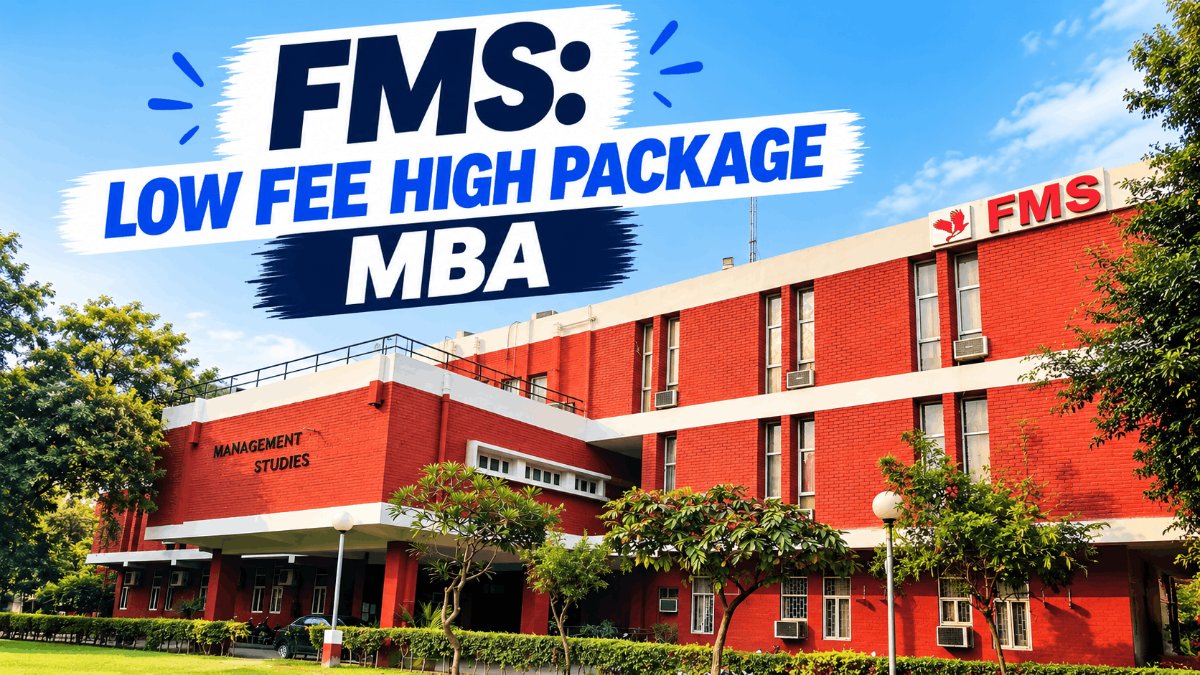
The trade is infrastructure and campus life, not placements or brand. You are attending a university department, not a 100-acre residential business school with a sports complex and a global exchange office. The classrooms, the hostels and the facilities are functional rather than impressive. The number of formal international exchange options is smaller than at a top IIM.
What you do not give up is recruiter access. McKinsey, BCG, Bain, Amazon, Goldman Sachs, Microsoft, HUL and ITC all recruit there. The Delhi location helps for consulting and BFSI roles in particular.
If two years of campus experience is a big part of what you want from an MBA, weigh it properly rather than letting a spreadsheet decide. If you mainly want the degree, the network and the job, the spreadsheet is telling you something real.
Getting in is the hard part
FMS publishes no official CAT cut-off. What circulates every year is community-reported, so treat the numbers as a guide rather than a bar.
The reported requirement for general category candidates in the recent cycle sat around 99+ percentile overall with roughly 98+ in each section. That is IIM Ahmedabad territory for a batch of about 307 seats.
The selection weightage, as reported, splits like this.
Component | Weight |
|---|---|
Weighted CAT score | 50 percent |
Personal interview | 15 percent |
Class 10 marks | 10 percent |
Class 12 marks | 10 percent |
Statement of purpose discussion | 10 percent |
Extempore | 5 percent |
One detail in there is worth your prep time. FMS is reported to re-weight the CAT sections before scoring, at VARC 40 percent, DILR 30 percent and QA 30 percent. If that holds, verbal is worth more here than at any IIM, where DILR usually carries the top weight. A strong VARC candidate is better placed at FMS than their overall percentile suggests.
The extempore and the SOP discussion together are 15 percent, which is unusual. Speaking clearly on a topic you did not prepare is a scored skill in this process, not a nice-to-have.
So is it the best ROI in the country?
On fee against package, yes, by a distance.
Be careful with how far you push that, though. A ratio rewards a small denominator, so a college charging 50,000 and placing at 6 lakh would beat every school in the table and ruin your career. The ratio only means something once you have already decided the school is one you would join, which is exactly what FMS is: a school with top-tier placements that happens to cost almost nothing.
Use it as a tiebreaker, not as a ranking. And remember the entry bar. A 99 percentile is what buys you that ROI, so the work between now and 29 November is the real investment here. Timed practice is at /practice.
Frequently Asked Questions
What is the total fee of the FMS Delhi MBA?
Rs 2,43,272 for the two-year full-time MBA in the 2026-28 batch, charged at Rs 60,818 a semester. Hostel charges and living costs are extra, at roughly Rs 4,000 to 5,000 a month plus one-time admission and caution money.
What was the FMS Delhi average package in 2026?
Rs 32.27 lakh for the 2024-26 batch, up from 30.1 lakh the previous year, with a median of 29.59 lakh and a highest package of 1.1 crore. The top decile averaged 60.67 lakh across 119 recruiters.
What CAT percentile is needed for FMS Delhi?
FMS does not publish an official cut-off. Community-reported figures for the recent cycle put the general category requirement near 99 percentile overall with around 98 in each section, with lower thresholds for reserved categories. Treat those as indicative.
Is FMS Delhi better than an IIM?
On cost, comfortably. On average package it sits within a few lakh of IIM Ahmedabad, Bangalore and Calcutta. On campus, facilities and international exposure, the top IIMs are ahead. Which matters more depends on what you want the two years to be.
Why is the FMS Delhi fee so low?
Because FMS is a department of Delhi University rather than an autonomous institute, so its fees follow a public university scale. The fee does rise, by about 4.85 percent for the current batch, but from a very low base.
Which other Indian B-school has a comparable ROI?
JBIMS Mumbai is the closest, at about Rs 8.34 lakh in fees against an average of 26.48 lakh, so a little over three times. That is far better than any IIM and still well short of FMS.
Frequently Asked Questions
What is the total fee of the FMS Delhi MBA?
Rs 2,43,272 for the two-year full-time MBA in the 2026-28 batch, charged at Rs 60,818 a semester. Hostel charges and living costs are extra, at roughly Rs 4,000 to 5,000 a month plus one-time admission and caution money.
What was the FMS Delhi average package in 2026?
Rs 32.27 lakh for the 2024-26 batch, up from 30.1 lakh the previous year, with a median of 29.59 lakh and a highest package of 1.1 crore. The top decile averaged 60.67 lakh across 119 recruiters.
What CAT percentile is needed for FMS Delhi?
FMS does not publish an official cut-off. Community-reported figures for the recent cycle put the general category requirement near 99 percentile overall with around 98 in each section, with lower thresholds for reserved categories. Treat those as indicative.
Is FMS Delhi better than an IIM?
On cost, comfortably. On average package it sits within a few lakh of IIM Ahmedabad, Bangalore and Calcutta. On campus, facilities and international exposure, the top IIMs are ahead. Which matters more depends on what you want the two years to be.
Why is the FMS Delhi fee so low?
Because FMS is a department of Delhi University rather than an autonomous institute, so its fees follow a public university scale. The fee does rise, by about 4.85 percent for the current batch, but from a very low base.
Which other Indian B-school has a comparable ROI?
JBIMS Mumbai is the closest, at about Rs 8.34 lakh in fees against an average of 26.48 lakh, so a little over three times. That is far better than any IIM and still well short of FMS.