Free CAT 2026 DILR Practice: Best Online DILR Resources
By Shweta Arora · Published 4 July 2026 · 5 min read · Common Admission Test
The best free DILR sets and sectional tests, plus the set-selection method that decides your score.
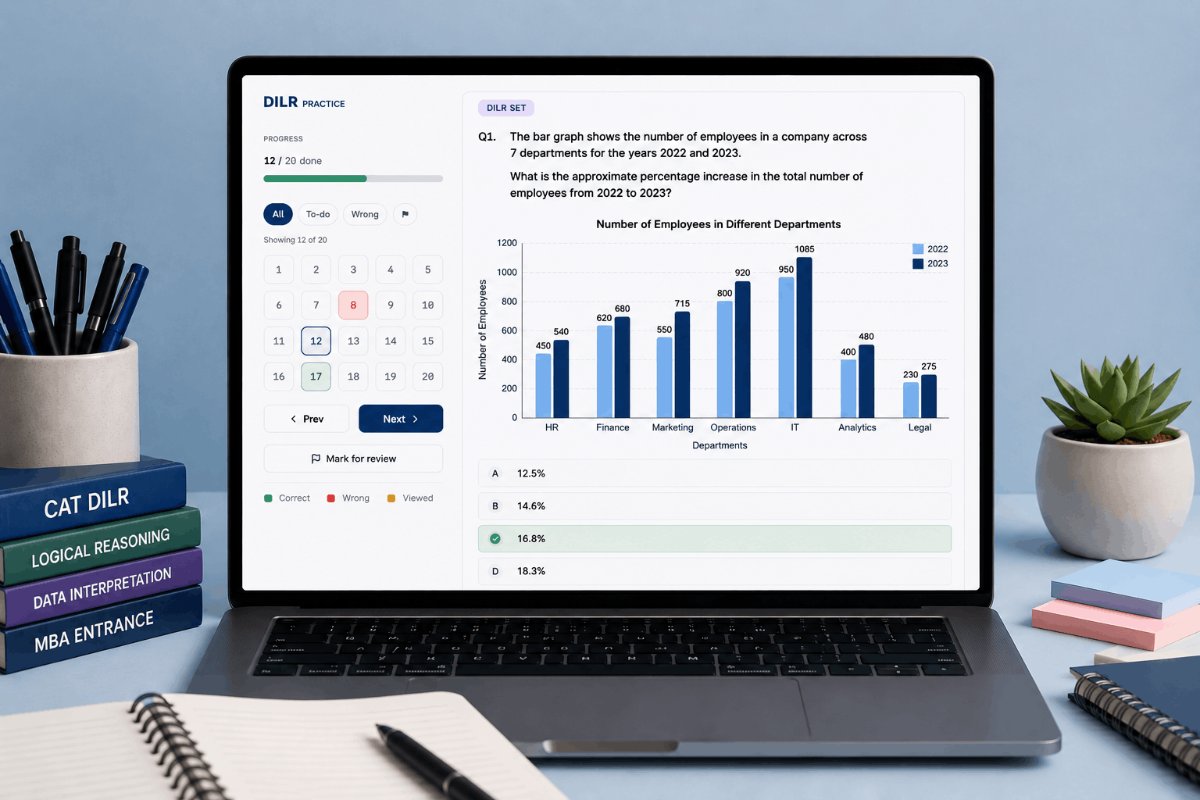 Preparing for CAT 2026? Solve 1000+ Free Questions on Percentyl
DILR section in CAT exam rewards two things above all: choosing the right sets to attempt and practising on a wide variety of them. You can get both for free.
Here are the best free DILR resources for concepts, practice sets and timed sectionals, with a method for using them so the section stops feeling like a lottery.
At a Glance
Item | Detail |
|---|---|
DILR (CAT 2026) | 22 questions in 40 minutes |
Old format | The 32-question, 60-minute paper is long gone |
Skill that wins | Set selection |
Top free sources | Percentyl, Cracku, 2IIM, Bodhee Prep, Hitbullseye |
Practice unit | Whole sets, timed |
What DILR looks like now
If you are working from old material, check the numbers. DILR in CAT 2025 had 22 questions in 40 minutes, not the 32 questions and 60 minutes you may still see quoted in older posts and books.
That shift changes your strategy. With four or five sets and only 40 minutes, you are not meant to solve everything. You are meant to find the two or three sets you can crack cleanly and bank them.
The best free DILR resources
All of these are free and active in 2026. Use the first for concepts and volume, the rest for variety and timed practice.
Resource | What you get for free |
|---|---|
Unlimited CAT-level DILR sets in the form of practice questions, topic tests, sectionals and mock tests | |
A free DILR series with new sets several times a week, over 1,000 practice questions and daily targets with video solutions | |
A free question bank with detailed solutions and no sign-up | |
More than 100 logical reasoning and DI sets graded by difficulty | |
Topic-wise DI and LR exercises, plus timed practice tests |
Set selection: the skill that decides your score
Most DILR scores are won or lost in the first few minutes, before you solve anything. Here is the routine I used and still recommend.
Scan every set first
Spend the opening two to three minutes reading all the sets once. Do not start solving. You are only judging difficulty and how much each set will demand.
Pick the two or three you can crack
Go for sets where you can see a way in within the first minute. Leave the ones that look open-ended or need heavy casework. A trap set can swallow fifteen minutes and give you nothing.
Commit, then move
Once you start a set, finish it. If you are stuck past a few minutes with no progress, leave it and switch. Sunk time is not a reason to stay.
A weekly DILR plan
Day | DILR practice |
|---|---|
Monday to Friday | 2 sets a day from a free source, mixed topics |
Saturday | Redo the sets you could not crack, without the clock |
Sunday | One timed sectional of 22 questions in 40 minutes, then analyse |
Build calculation speed alongside
DILR is full of arithmetic, so slow calculation costs you sets. Keep a reference sheet of tables, squares, cubes and fraction-to-percentage conversions, the same Golden Book idea that helps in Quant.
Practising approximation matters as much as exact math. In many DI sets you only need to know which option is closest, not the precise value.
What good DILR practice looks like
Volume alone does not move your DILR score. How you review does.
After every set, redo it slowly without the clock and ask why you got stuck or why it flowed. Note whether the set was easy or hard for you and the trick that cracked it. Over time, you build a feel for which sets to attempt, which is the whole game in DILR.
The mistake that quietly kills DILR scores
The biggest DILR error is not a wrong answer. It is staying too long in a set that is not working.
Sunk time feels like a reason to push on. It is not. If ten minutes in you have solved nothing, the smart move is to drop the set and pick another, even though it stings. One abandoned set costs you a few minutes. One set you refuse to leave can cost you the section.
Practise this in mocks, not just on exam day. Train yourself to walk away from a set, because that habit is as important as solving skill.
Frequently Asked Questions
How many DILR sets should I solve daily?
Two well-analysed sets a day is a solid baseline, with a timed sectional at the weekend. Reviewing why a set worked or failed matters more than the count.
How do I choose which sets to attempt in the exam?
Scan all sets in the first two to three minutes, then pick the two or three with a clear way in. Leave open-ended, calculation-heavy sets that can eat your time.
Is DILR the toughest CAT section?
It is the least predictable, which is why set selection matters so much. The good news is you only need a few clean sets to score well.
Can I prepare DILR for free without coaching?
Yes. Percentyl, Cracku, 2IIM, Bodhee Prep and Hitbullseye together give you more sets than you can finish. Free resources are more than enough for DILR.
Should I practise DI and LR separately?
Early on, yes. Build DI and LR skills in separate sessions so each gets real focus. Closer to the exam, mix them, because CAT gives you a blind set of both and you need to switch between them under time pressure.
Frequently Asked Questions
How many DILR sets should I solve daily?
Two well-analysed sets a day is a solid baseline, with a timed sectional at the weekend. Reviewing why a set worked or failed matters more than the count.
How do I choose which sets to attempt in the exam?
Scan all sets in the first two to three minutes, then pick the two or three with a clear way in. Leave open-ended, calculation-heavy sets that can eat your time.
Is DILR the toughest CAT section?
It is the least predictable, which is why set selection matters so much. The good news is you only need a few clean sets to score well.
Can I prepare DILR for free without coaching?
Yes. Percentyl, Cracku, 2IIM, Bodhee Prep and Hitbullseye together give you more sets than you can finish. Free resources are more than enough for DILR.
Should I practise DI and LR separately?
Early on, yes. Build DI and LR skills in separate sessions so each gets real focus. Closer to the exam, mix them, because CAT gives you a blind set of both and you need to switch between them under time pressure.