Free CAT 2026 Reading Comprehension Practice: Best Daily RCs
By Shweta Arora · Published 2 July 2026 · 5 min read · Common Admission Test
Where to practise reading comprehension online for free, plus how to make every passage count.
 Preparing for CAT 2026? Solve 1000+ Free Questions on Percentyl
If you want to practice Reading Comprehension for CAT without spending a rupee, a few free resources cover almost everything: graded passages, an exam-style screen and properly explained answers.
Here are the ones worth your time and, just as important, how to use them so practice moves your VARC score instead of just filling hours.
At a Glance
Item | Detail |
|---|---|
VARC (CAT 2026) | 24 questions in 40 minutes |
RC share | Around 16 of the 24 VARC questions |
Where to practise | Online, not on paper |
Top free sources | Percentyl, Bodhee Prep, Wordpandit, Cracku, 2IIM, Hitbullseye |
Daily target | 3 to 4 passages in the final two months |
Practice RC online, not on paper
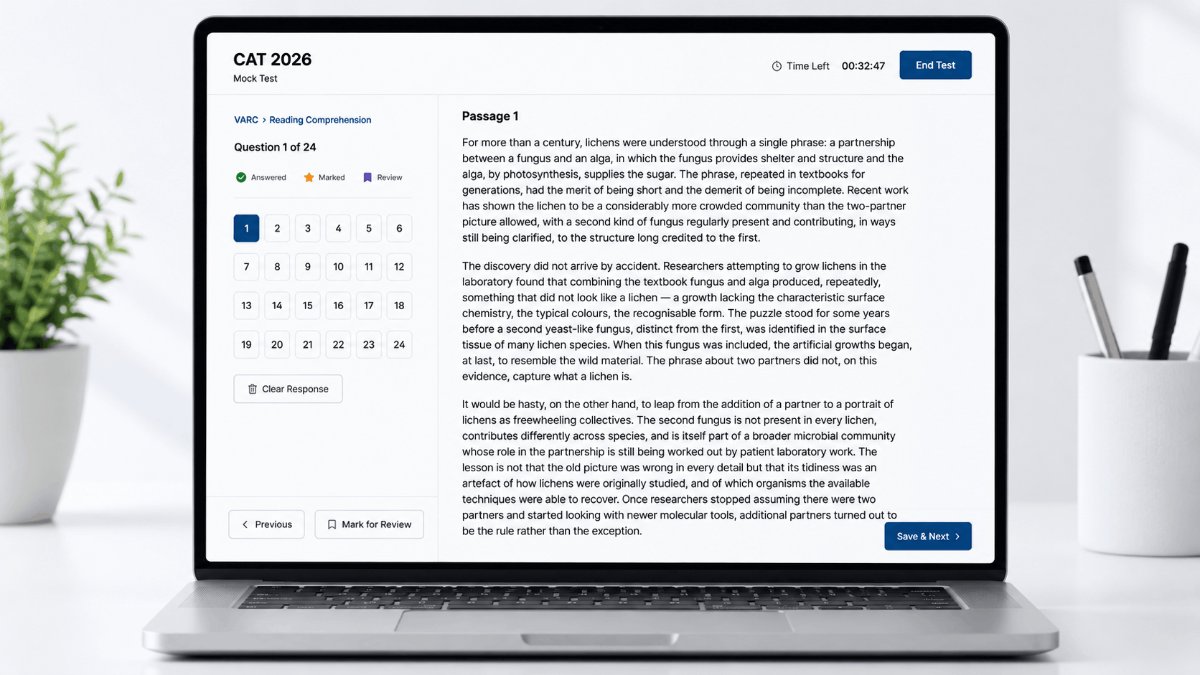
CAT is a computer-based test. You read the passage on screen, scroll and click options on a split layout. That experience is different from reading a printed passage with a pen in hand.
If all your practice is on paper, the screen will slow you down on exam day. Do most of your RC practice online so the format feels normal long before November.
The best free RC resources
Each of these is free and still active in 2026. Below is a table that mentions what makes each one useful, so you can pick by what you need.
Resource | What you get for free |
|---|---|
Unlimited RCs for CAT practice in the form of practice questions, daily RC passages, topic tests and mocks | |
Over 500 RC practice questions and a free RC course, with video solutions that explain the logic behind each option | |
Passages graded level 1 to 3 on a CAT-style screen, with answer explanations | |
More than 800 RC questions with video solutions, plus free daily practice sets | |
A free question bank with clean, detailed solutions and no sign-up | |
Timed RC practice tests you can use as mini sectionals |
Daily RC practice
Practising RCs on a daily basis encourages you to stay consistent. There is a Daily RC section offered on Percentyl which offers a unique CAT-level RC for 24 hours and a new one surfaces at 12 AM IST. It has a streaks system which keeps the users motivated to show up daily.
Why RC solutions matter
Getting an answer right is not the same as knowing why the other three options were wrong. The best RC learning comes from the explanation, not the score.
This is why I rate resources with worked solutions above plain question dumps. For every passage, read the reasoning for each option you ruled out. That habit, not raw volume, is what lifts accuracy.
How to practise so it counts
Accuracy before speed
For the first month, forget the clock. Solve passages slowly and aim to get almost every question right. Speed without accuracy just means more confident, wrong answers.
Master option elimination
Most RC options are wrong for a reason: too extreme, out of scope, a distortion of the text or true but beside the point. Name the flaw for each option you reject. CAT tests this skill more than vocabulary.
Read long-form every day
Twenty minutes of daily reading from good editorials, long essays and quality magazines builds the stamina RC needs. Pick topics you find dull on purpose, because CAT will hand you a dense passage on something you do not care about.
A simple weekly RC routine
Here is a plan that works in the final two months without taking over your day.
Day | RC practice |
|---|---|
Monday to Friday | 3 passages a day, untimed at first, then timed |
Saturday | Review every wrong answer from the week, name the trap |
Sunday | One timed VARC sectional test, then analyse it |
Keep a simple practice log
Numbers tell you more than a vague sense of progress. After each passage, jot down three things.
Track your accuracy, the time the passage took and the type of question you missed. Over a few weeks the pattern is obvious. Maybe inference questions trip you up, or maybe long science passages eat your clock.
Once you can see the leak, you can fix it. A practice log turns RC from a guessing game into a problem you can solve.
Turn reading into a daily habit
RC is not a topic you can cram. It is a skill that grows with how much you read, so the earlier you start, the easier the section feels.
Read one long article a day from a source outside your comfort zone. Philosophy, economics, art criticism and history all show up in CAT passages. The aim is not to enjoy every piece. It is to stay sharp on dense, unfamiliar prose so nothing in the exam feels alien.
Keep a running list of words you had to look up. You do not need to memorise vocabulary lists for CAT, but knowing the words that appear in real articles helps you read faster.
Frequently Asked Questions
How many RC passages should I solve daily?
Three to four a day in the last two months is plenty if you analyse each one. Quality of review beats raw count.
Is online RC practice better than books?
For CAT, yes. The exam is on screen, so practising online trains the reading and scrolling you will do on the day. Keep books for leisure reading.
Which free resource is best for a beginner?
Start with Percentyl, Bodhee Prep or Cracku for the quality of solutions. Seeing why each option is right or wrong teaches the method faster than solving alone.
How do I improve RC accuracy?
Slow down, eliminate options by naming their flaw and read long-form text daily. Accuracy comes from method and reading habit, not speed.
Do I need a paid course for RC?
No. The free resources here give you more passages than you can finish, with explanations good enough to learn the method. A paid course helps mainly if you want structure and feedback, not because the free material is thin.
Frequently Asked Questions
How many RC passages should I solve daily?
Three to four a day in the last two months is plenty if you analyse each one. Quality of review beats raw count.
Is online RC practice better than books?
For CAT, yes. The exam is on screen, so practising online trains the reading and scrolling you will do on the day. Keep books for leisure reading.
Which free resource is best for a beginner?
Start with Percentyl, Bodhee Prep or Cracku for the quality of solutions. Seeing why each option is right or wrong teaches the method faster than solving alone.
How do I improve RC accuracy?
Slow down, eliminate options by naming their flaw and read long-form text daily. Accuracy comes from method and reading habit, not speed.
Do I need a paid course for RC?
No. The free resources here give you more passages than you can finish, with explanations good enough to learn the method. A paid course helps mainly if you want structure and feedback, not because the free material is thin.