How to Crack Consulting Case Interviews: A Prep Plan
By Shweta Arora · Published 19 August 2026 · 4 min read · Master in Business Administration (MBA)
You crack consulting case interviews by getting good at guesstimates plus a few frameworks, then practising 30 to 50 real cases out loud with a partner. Most of the material you need is free. The skill is not raw intelligence. It is a way of breaking a problem down that you can learn with reps.
 Preparing for CAT 2026? Solve 1000+ Free Questions on Percentyl
You crack consulting case interviews by getting good at guesstimates plus a few frameworks, then practising 30 to 50 real cases out loud with a partner. Most of the material you need is free. The skill is not raw intelligence. It is a way of breaking a problem down that you can learn with reps.
A case interview is where the interviewer hands you a business problem, say a company losing profit, then you solve it live while talking through your thinking. Firms like McKinsey, BCG plus Bain use it to see how you reason. This plan is the one serious consulting aspirants at the IIMs follow, ordered from the basics to the harder stuff.
At a Glance
Step | What to do |
|---|---|
Guesstimates | Learn to estimate numbers from scratch, like trains in a metro |
Case structuring | Watch a workshop to see how cases are broken down |
Frameworks | Learn profitability, market entry, pricing and M&A |
Casebooks | Practise from IIM, HBS and ISB case collections |
Practice out loud | Solve in a group of three, rotating roles |
Volume | Do 30 to 50 cases before interviews |
Start with guesstimates
If you are starting from zero, guesstimates come first. A guesstimate asks you to estimate a number with no data, like how many trains run on the Delhi metro. You break it into parts you can reason about, then build back up. It teaches the structured thinking every case needs, so get comfortable here before anything else. Plenty of free videos walk through worked examples.
Learn to structure a case
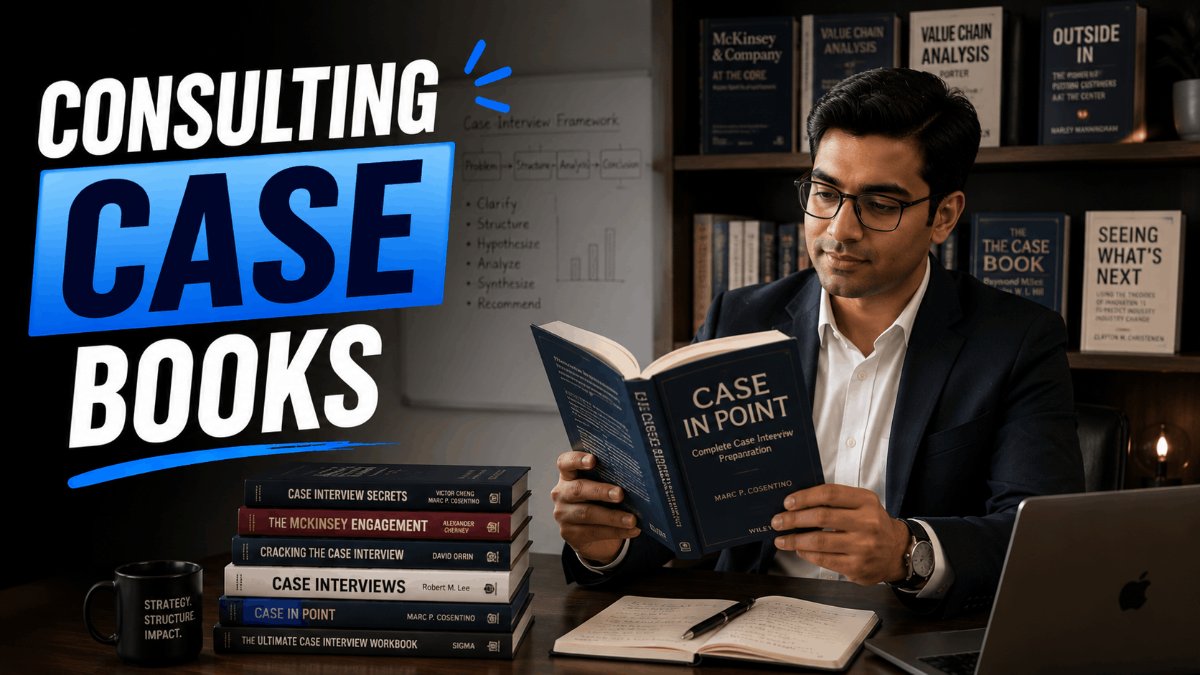
Next, learn how a case is broken down plus how the answer is communicated. The best-known free resource is Victor Cheng's Case Interview Secrets, a workshop of about a dozen videos. The classic book is Case in Point by Marc Cosentino. Between them you get the vocabulary plus the habits of a clean case, from asking clarifying questions to stating a structure before you begin.
Know the common case types
Most cases are versions of a few types. Profitability, where profit has fallen plus you find why. Market entry, where a firm weighs a new market. Pricing, where you set the price of a product. Mergers plus acquisitions, where a company weighs a buy. Learn a simple structure for each. You are not memorising templates, you are building a starting map you can adapt to the specific case.
Use the casebooks
Business schools publish casebooks full of real interview questions with solutions. The ones widely used at the IIMs include the IIM-A plus IIM-B case books, the Harvard Business School book, the ISB book plus the Wharton book. Work through cases from these, since they mirror what firms really ask. Many are shared freely by consulting clubs.
When to start
Give yourself at least two to three months before interview season, more if you are starting cold. Cases reward reps, plus the improvement curve is slow at first then steep. Spread your practice out rather than cramming, since a case a day for two months beats forty cases in a fortnight. If you are targeting summer placements at a b-school, begin the moment term one settles down.
Practise out loud, in a group
Reading cases is not practice. Solving them aloud is. Work in a group of three where one plays the interviewer, one the interviewee plus one the observer who notes what to fix. Rotate the roles each time. Speaking your logic under a little pressure is the exact skill the interview tests, so simulate it. Record a few sessions if you can, since hearing yourself back shows the filler words plus the leaps in logic you miss in the moment.
How many cases?
Serious consulting aspirants at IIM-A solve at least 40 to 50 cases to get the structure, the clarifying questions plus the communication right. At an undergraduate level, aim to do around 30 cases with a partner, then read through more on your own. The first ten feel clumsy. By case thirty the structure starts to feel natural, which is the whole point.
Frequently Asked Questions
What is a consulting case interview?
It is an interview where you solve a live business problem out loud while the interviewer follows your reasoning. Firms like McKinsey, BCG plus Bain use it to test how you structure and communicate a solution.
Where do I start if I know nothing about cases?
Guesstimates. Learn to estimate a number from scratch by breaking it into parts. It builds the structured thinking every case needs. Free worked-example videos are easy to find.
How many cases should I solve before interviews?
Around 40 to 50 for serious MBA aspirants, or about 30 at the undergraduate level, then read more on your own. Volume is what turns structure into a habit.
Can I prepare for case interviews for free?
Mostly yes. Guesstimate videos, Victor Cheng's workshop plus the school casebooks shared by consulting clubs cover most of it. Case in Point is a small paid addition if you want a book.
How should I practise cases?
Out loud, in a group of three, rotating interviewer, interviewee plus observer. Solving aloud under mild pressure is the skill the interview really measures.
Frequently Asked Questions
What is a consulting case interview?
It is an interview where you solve a live business problem out loud while the interviewer follows your reasoning. Firms like McKinsey, BCG plus Bain use it to test how you structure and communicate a solution.
Where do I start if I know nothing about cases?
Guesstimates. Learn to estimate a number from scratch by breaking it into parts. It builds the structured thinking every case needs. Free worked-example videos are easy to find.
How many cases should I solve before interviews?
Around 40 to 50 for serious MBA aspirants, or about 30 at the undergraduate level, then read more on your own. Volume is what turns structure into a habit.
Can I prepare for case interviews for free?
Mostly yes. Guesstimate videos, Victor Cheng's workshop plus the school casebooks shared by consulting clubs cover most of it. Case in Point is a small paid addition if you want a book.
How should I practise cases?
Out loud, in a group of three, rotating interviewer, interviewee plus observer. Solving aloud under mild pressure is the skill the interview really measures.