Last 20 Days Before CAT 2026: What to Revise and Skip
By Shweta Arora · Published 11 November 2026 · 8 min read · Exam Preparation
CAT 2026 is on 29 November. Here is what to revise in the final 19 days, using topic counts from 18 past papers, plus the official interface rules worth practising now.
Preparing for CAT 2026? Solve 1000+ Free Questions on Percentyl
CAT 2026 is on Sunday, 29 November, which leaves 19 days from 10 November. In the last 20 days before CAT, stop learning new chapters. Revise the topics that appear in every paper, take two or three full mocks a week in the 120-minute format, and practise on the official mock and calculator.
This stretch decides more marks than most people expect. Your concepts are largely set by now. What still moves is how you choose questions, how calmly you use 40 minutes per section, and whether the small errors you keep repeating get fixed before the real paper.
CAT 2026 final 20 days at a glance
| Detail | Value |
|---|---|
| Exam date | Sunday, 29 November 2026, in three sessions |
| Admit card download | 6 November to 29 November 2026, on iimcat.ac.in |
| Official mock test | On the CAT website from 6 November 2026 |
| Duration | 120 minutes, 40 minutes per section (PwBD candidates get 40 minutes extra) |
| Moving between sections | Only after the section's 40 minutes are over |
| Calculator | On-screen, mouse only; keyboard operation is disabled |
| Result | Likely by the first week of January 2027 |
| Score validity | Until 31 December 2027 |
Source: iimcat.ac.in (CAT 2026 Information Bulletin, admit card media release of 4 November 2026, mock test and calculator guidelines), read 10 November 2026.
Quick tips
- Revise the chapters that appear in every paper first: Linear & Quadratic Equations, Geometry and Number System.
- Keep Reading Comprehension daily: it carried 294 questions across the last 18 papers.
- In DILR, practise Quant-based Computation sets, the most frequent set type in past papers.
- Sit the official mock on the CAT website to rehearse the 40-minute section lock.
- Download your admit card between 6 and 29 November and check your test centre.
What should you study in the last 20 days before CAT?
Study only what you have already learnt, ranked by how often it appears. Past papers are the best guide to that. Across the 18 CAT papers from 2020 to 2025 (three slots a year), a handful of topics turn up in almost every slot.
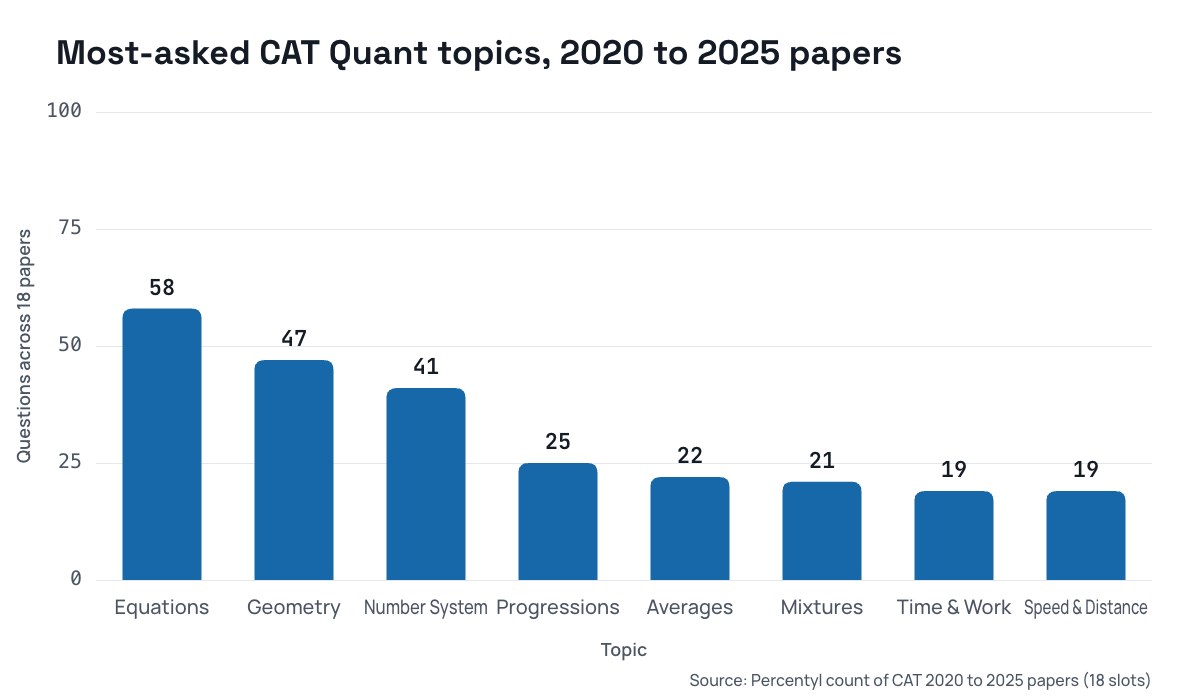
- Quant: Linear and Quadratic Equations (58 questions), Geometry (47) and Number System (41) appeared in all 18 papers. Progressions and Mixtures and Alligations appeared in 17.
- VARC: Reading Comprehension accounted for 294 questions across all 18 papers. Para Summary appeared in all 18, Para-jumbles in 15.
- DILR: Quant-based Computation sets, where the work is arithmetic on tables and charts, accounted for 135 questions across 15 papers, far ahead of any other set type.
The chart below shows the Quant topics that came up most. If one of these is still weak, spend your revision hours here rather than on a chapter you have never touched.
Source: Percentyl count of CAT 2020 to 2025 papers (18 slots)
A new chapter learnt in week three of November rarely survives exam pressure. Revising Equations, Geometry formulae and divisibility rules you already know will return far more marks per hour.
How many mocks should you take before CAT 2026?
Two or three full mocks a week is enough for most people now, with the last one about four or five days before the exam. More than that leaves no time to analyse, and an unanalysed mock teaches you very little.
Give each mock the same weight as the paper. Sit at the time your slot will run, in one go, with no phone. Then spend at least as long reviewing it as you spent writing it. Look for three things only:
- Questions you got wrong that you knew how to solve. These are your cheapest marks.
- Questions you spent more than four minutes on and then left. These are your time leaks.
- Easy questions you never opened. These show whether your first pass through each section is working.
Between mocks, use Sectional tests for the section you feel least sure of. A 40-minute sectional on a weekday keeps the rhythm without the fatigue of a full paper.
Why practise on the official CAT mock and calculator?
Because the interface has rules that coaching mocks do not always copy. In the real exam you can move to the next section only after its 40 minutes are over. The official mock enables a Submit button for each section so you can explore it, but on 29 November that option will not exist. Plan to use every minute of each section.
The official mock contains selected questions from previous CAT papers, so treat it as one more past paper. Take it once, early in these three weeks, under timed conditions.
The on-screen calculator works with the mouse only, because keyboard operation is disabled. Its percentage key also behaves differently from a phone calculator. The official guideline says that to add 15% to 250 you press 250 + 15 % 250 =, which gives 287.5. Try the calculator a few times now so that you do not discover this mid-section. For most DILR calculations, approximating by hand is still faster.
How should you plan each section in the final weeks?
Fix your section plan now and practise only that plan in every mock. Changing strategy in the last week usually costs more than it gains.
VARC
Read one or two passages a day outside mocks, timed, from mixed subjects. Since Reading Comprehension makes up most of the section, your RC accuracy matters more than your speed on verbal ability. Do Para Summary questions regularly; they appear in every paper and reward the same skill as RC.
DILR
Your job in the first two or three minutes is selection: scan all the sets and start with the one whose structure is clearest. Calculation-heavy sets appear most often, so keep your percentage and ratio work sharp. Leave a set the moment you realise you have misread a condition, rather than forcing it.
Quant
Go through the paper in rounds. Attempt the questions that look direct first, mark the longer ones, and return to them only after the first pass. Keep a one-page list of formulas for Geometry, Progressions and Logarithms and read it every morning.
What should you do in the last week before the exam?
Taper. The final week is for confidence, not volume. Use this checklist:
- Download your admit card from iimcat.ac.in, print it and check the centre address, reporting time and photo.
- Visit or map the route to your test centre, and note how long it takes at that time of day.
- Take your last full mock four or five days before the exam, then analyse it lightly.
- Revise your error log and formula sheet; solve a few easy questions daily to stay warm.
- Keep your sleep in line with your slot timing for at least the last five nights.
- Take the day before CAT off from mocks entirely.
The IIMs have said that face matching and mobile jammers will be used at select locations, so carry the documents your admit card asks for and expect stricter checks at the gate.
What to do next
Pick your weakest high-frequency topic from the list above and give it the next three days. Use the CAT previous year papers to practise that topic in its real form, keep the Formula book open while you revise Quant, and do the Daily RC every morning to keep your reading sharp. Book two Full-length mocks for this week now, at the time of your slot, and put an hour in your diary after each one for analysis.
Your result will come by the first week of January 2027 and the score stays valid until 31 December 2027, so nothing about the next 19 days is the last word on your MBA. Treat them as practice for one calm, well-planned morning.
Frequently Asked Questions
Is 20 days enough to improve my CAT score?
Yes, if you spend it on revision and mock analysis rather than new chapters. Most gains in the final weeks come from fixing repeated errors, choosing questions better and managing 40 minutes per section. A new topic learnt now rarely holds up under exam pressure.
How many mocks should I take in the last 20 days before CAT?
Two or three full mocks a week is enough for most candidates, with the last one four or five days before the exam. Spend at least as long analysing each mock as you spent writing it. Add sectional tests on weekdays for your weakest section.
Should I start a new topic three weeks before CAT?
Generally no. Revise the high-frequency topics you already know, such as equations, geometry and number system in Quant. Only pick up something new if it is small, appears regularly in past papers and you can practise it properly before the exam.
When is the CAT 2026 official mock test available?
The IIMs said the official mock test would be available on the CAT website from 6 November 2026. It uses selected questions from previous CAT papers and the real exam interface. Take it once under timed conditions and practise with the on-screen calculator.
Can I switch sections early in CAT 2026?
No. In the actual exam you can move to the next section only after its 40 minutes are over. The official mock has a Submit button for each section to let you explore, but that option does not exist on exam day, so plan to use the full time in every section.
What should I do the day before CAT 2026?
Take the day off from mocks. Check your admit card, ID and route to the centre, revise your formula sheet lightly and sleep at a time that suits your slot. Arriving rested is worth more than one extra practice set.