The Comprehension Trick Every IIM Student Uses (and You Can Too)
By Shweta Arora · Published 12 August 2026 · 4 min read · Exam Preparation
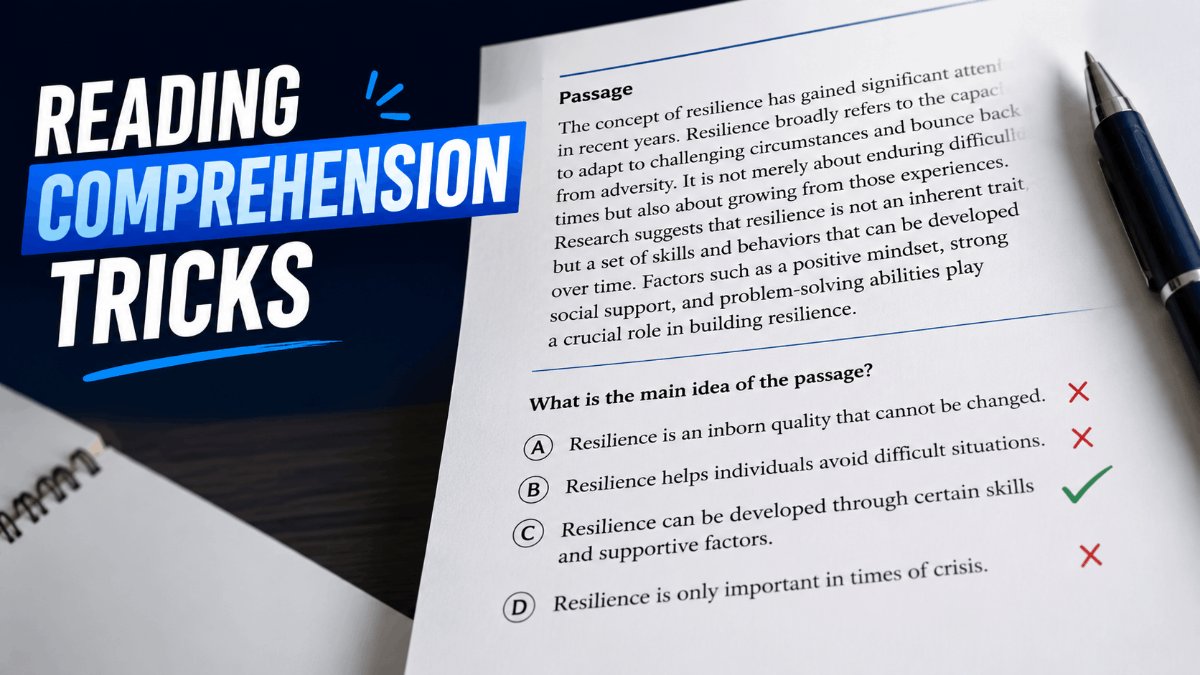
Strong reading comprehension is not about reading fast or knowing hard words. It is a small set of habits: skim for what matters, ignore the numbers, follow the transition words plus catch the main idea of each paragraph. IIM students do this without thinking. You can learn the same habits before CAT.
 Preparing for CAT 2026? Solve 1000+ Free Questions on Percentyl
Strong reading comprehension is not about reading fast or knowing hard words. It is a small set of habits: skim for what matters, ignore the numbers, follow the transition words plus catch the main idea of each paragraph. IIM students do this without thinking. You can learn the same habits before CAT.
In the first year at IIM Ahmedabad we get through roughly 40 courses, each with a case or a book or both. Nobody survives that reading load by reading every word. The habits that make it possible are the exact ones we built preparing for RC. I come from a non-maths background, so reading was my home ground. These are the moves that mattered.
The seven habits at a glance
Habit | What it means |
|---|---|
Skim for meaning | Read only the words that carry the idea, not every word |
Skip the figures | Do not memorise numbers, just know where they sit |
Track transition words | Watch despite, nor, even, not, since they flip or link ideas |
Use the comma effect | Ignore the bit between commas when it only adds detail |
Guess vocabulary | Work out a hard word from the sentence around it |
One line per paragraph | Sum up each paragraph in a few words |
Read first, answer later | Finish the passage before touching the questions |
Skim for meaning, not speed
Skimming does not mean reading quickly. You can read a high number of words a minute and still understand nothing. Skimming means reading only the words that carry the meaning. In most lines, a chunk of words are just there to hold the sentence together.
Take a sentence like this: a second Budget is not a spend-and-stimulate exercise despite the fact that it has overrun its fiscal deficit target. Read only the load-bearing words, so not a spend-and-stimulate exercise despite overrun target. You keep the full sense from about half the words. Do that across a passage and you save a lot of time without losing the thread.
Skip the figures, remember where they live
Notice that the meaning above survived without a single number. As a manager, a student or a candidate in the exam hall, you can always look back at a figure if a question needs it. What you have to hold in your head is where the number sits, not the number itself. Reading to memorise data is wasted effort.
Follow the transition words
Small words steer a passage. Despite, nor, even, since plus however tell you how one idea connects to the last. If a line says nor is it a feel-good budget even accounting for lower tax rates, the word even signals that what follows was expected to please people. Watch the negatives too. Not and does not are easy to skim past, yet they flip the whole meaning.
The comma effect
Commas often wrap a phrase that adds detail but no core meaning. Read this: my grandmother, who is old and sick, cannot go out of the house. The main idea is that she cannot go out. The part between the commas is an add-on. You could swap those commas for brackets and read straight past them. Spotting these lets you move faster through dense sentences.
Stop mugging up vocabulary
Comprehension does not run on how many rare words you know. Very few IIM students are heavy novel readers, whatever the stereotype says. What they do well is read a whole sentence to work out one unfamiliar word. The words around it almost always give it away. So build the habit of inferring meaning from context instead of memorising word lists.
One line per paragraph
In a passage of six or seven paragraphs, each paragraph circles one theme. After reading one, put its essence into a single line, sometimes just two or three words. Do this through the passage and you end up with a tiny map of the whole thing. It sounds slow at first. With practice it turns automatic. Even now we use it on long cases and research papers.
Read the whole thing, then answer
Do not read in bits and jump to the questions between paragraphs. Finish the passage first. By the end you know the main idea plus where each point sits. Then go to the questions. Many CAT RC questions pull from more than one paragraph, so a full read beats a stop-start one every time.
Frequently Asked Questions
Does reading faster improve my RC score?
Not on its own. Speed without skimming the right words gives you more words read and no more understood. Learn to read only the load-bearing words, then speed follows naturally.
Do I need a strong vocabulary for CAT RC?
No. Comprehension depends far more on reading a word in context than on knowing rare words. Practise guessing meaning from the sentence around a tough word instead of memorising lists.
Should I read the questions before the passage?
For most RC passages, read the full passage first, then the questions. CAT questions often draw on more than one paragraph, so a complete read serves you better than a stop-start one.
How do I practise these habits?
Take one dense editorial or passage a day. Underline only the meaningful words, write a one-line summary per paragraph plus note where the figures are. In a few weeks the habits become automatic.
Frequently Asked Questions
Does reading faster improve my RC score?
Not on its own. Speed without skimming the right words gives you more words read and no more understood. Learn to read only the load-bearing words, then speed follows naturally.
Do I need a strong vocabulary for CAT RC?
No. Comprehension depends far more on reading a word in context than on knowing rare words. Practise guessing meaning from the sentence around a tough word instead of memorising lists.
Should I read the questions before the passage?
For most RC passages, read the full passage first, then the questions. CAT questions often draw on more than one paragraph, so a complete read serves you better than a stop-start one.
How do I practise these habits?
Take one dense editorial or passage a day. Underline only the meaningful words, write a one-line summary per paragraph plus note where the figures are. In a few weeks the habits become automatic.