The Rounds Technique: How CAT Toppers Attempt Quant
By Shweta Arora · Published 21 August 2026 · 4 min read · Common Admission Test
Your Quant score is decided less by what you know plus more by which questions you choose to attempt. The rounds technique, used by many CAT toppers, is a way to sweep the section in passes so you grab every easy question first plus never get stuck burning minutes on a hard one. This is about how to attempt QA, not how to prepare it.
 Preparing for CAT 2026? Solve 1000+ Free Questions on Percentyl
Your Quant score is decided less by what you know plus more by which questions you choose to attempt. The rounds technique, used by many CAT toppers, is a way to sweep the section in passes so you grab every easy question first plus never get stuck burning minutes on a hard one. This is about how to attempt QA, not how to prepare for it.
Quick context on the current format. In CAT, the Quant section has 22 questions in 40 minutes, with plus three for a correct answer plus minus one for a wrong MCQ. Type-in-the-answer questions carry no negative marking. Every question is worth the same, so a hard question is worth exactly as much as an easy one. That single fact is why the rounds technique works.
Who this is for
If you are taking mocks plus your Quant score is low, there are only two causes: low attempts or low accuracy. If accuracy is the problem, you need to revisit basics plus practise more. If low attempts is the problem, you are either not done with the syllabus or you are spending your time on the wrong questions. The rounds technique fixes that second one.
The three questions worth hunting
Since every question scores the same, your job is to find the ones you can bank fastest. There are three kinds that often overlap: easy questions built on a single formula, short one-liner questions plus familiar questions where you already know the trick. The whole point of the rounds is to hunt these down instead of solving in the order they appear. Miss an easy question buried at the end because you got stuck early, plus you have thrown away three free marks.
How the three rounds work
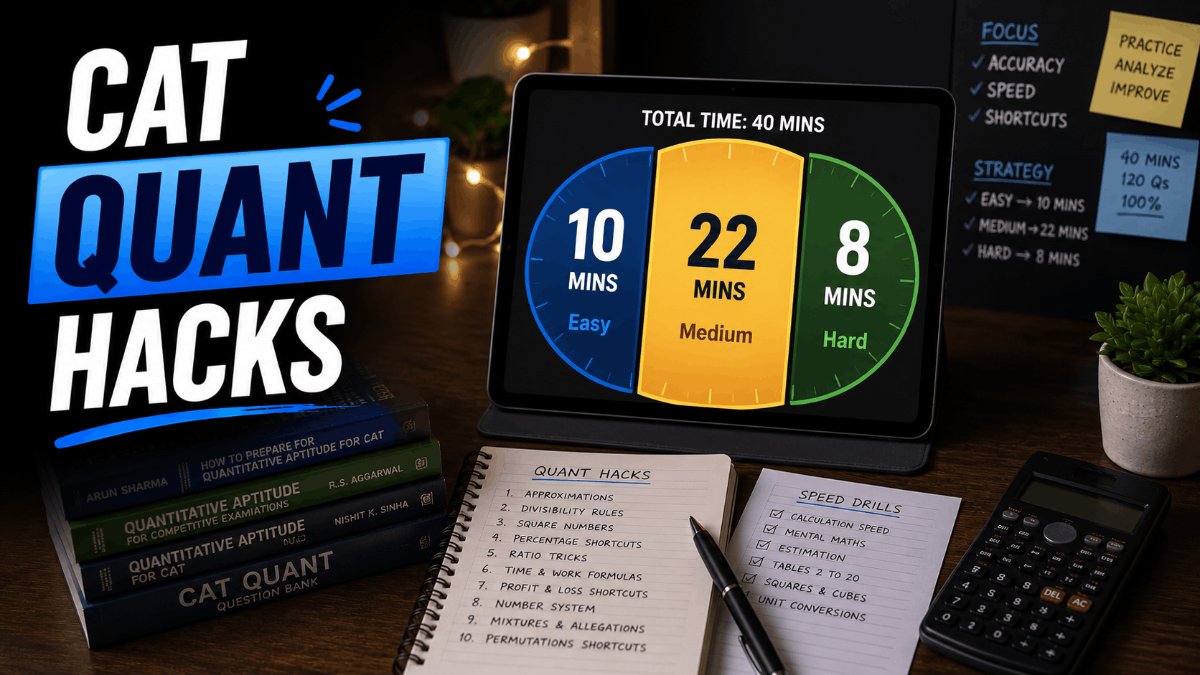
Round | Time | Goal |
|---|---|---|
Round 1 | About 10 min | Read all 22, attempt the easy ones, mark the rest for review |
Round 2 | About 22 min | Solve the familiar and lengthy questions from your review list |
Round 3 | About 8 min | Close near-misses, then guess the type-in questions since they carry no penalty |
Round 1, about 10 minutes
Go from the first question in order. Spend only ten to fifteen seconds reading each one. If a question is long, skip it for now. If it looks easy, solve it in under a minute. By the end you will have read all 22 questions plus banked the easy ones, often five or six. As you read, mark two kinds for review: easy ones you could not crack quickly plus familiar ones that looked lengthy.
Round 2, about 22 minutes
Now work your review list, starting from the front of the paper, not at random. Here is the trap to avoid. If you start with an easy question you failed earlier, you fall into the ego trap, thinking how can I not solve this, then you lose five minutes to pride. So begin fresh plus follow simple rules: try each question for thirty seconds, plus if you see the path, give it up to another ninety seconds. If you are not close, leave it. Note the ones you were nearly through when time ran out.
Round 3, about 8 minutes
Use the last stretch on the near-misses you noted, the ones where a small slip or a forgotten formula stopped you. Then, in the final minute, put an answer on every type-in question you have not attempted. They carry no negative marking, so a guess can only help. Never leave a no-penalty question blank.
Make it yours
The exact split, so ten, twenty-two plus eight minutes across three rounds, is what worked for me. Yours may differ. Some people run two rounds, some four. Test different splits across your mocks plus keep the one that gets you the most right answers. The principle stays the same whatever the timing: sweep for the easy marks first. Never let one stubborn question eat your section. Lock your split a few mocks before the real exam, so it feels automatic on the day.
Frequently Asked Questions
How many questions are in the CAT Quant section now?
The Quant section has 22 questions in 40 minutes, with plus three for a correct answer and minus one for a wrong MCQ. Type-in-the-answer questions have no negative marking.
What is the rounds technique?
It is a way to attempt the Quant section in passes. You read everything and grab the easy questions first, then tackle the familiar and lengthy ones, then use the last minutes on near-misses and no-penalty guesses.
Should I attempt questions in order?
Read them in order, but do not solve in order. Solve the easiest and most familiar questions first, whatever their position, since every question carries the same marks.
What is the ego trap?
It is getting stuck on an easy question you failed earlier, refusing to move on out of pride, then losing several minutes. Start each round fresh and leave stubborn questions behind.
Should I guess on the type-in questions?
Yes. Type-in-the-answer questions carry no negative marking, so put an answer on every one before time runs out. A blank scores zero, while a guess might land.
Frequently Asked Questions
How many questions are in the CAT Quant section now?
The Quant section has 22 questions in 40 minutes, with plus three for a correct answer and minus one for a wrong MCQ. Type-in-the-answer questions have no negative marking.
What is the rounds technique?
It is a way to attempt the Quant section in passes. You read everything and grab the easy questions first, then tackle the familiar and lengthy ones, then use the last minutes on near-misses and no-penalty guesses.
Should I attempt questions in order?
Read them in order, but do not solve in order. Solve the easiest and most familiar questions first, whatever their position, since every question carries the same marks.
What is the ego trap?
It is getting stuck on an easy question you failed earlier, refusing to move on out of pride, then losing several minutes. Start each round fresh and leave stubborn questions behind.
Should I guess on the type-in questions?
Yes. Type-in-the-answer questions carry no negative marking, so put an answer on every one before time runs out. A blank scores zero, while a guess might land.