CAT 2026 in 100 Days: The 5-Phase Plan to 99 Percentile
By Shweta Arora · Published 19 August 2026 · 7 min read · Exam Preparation
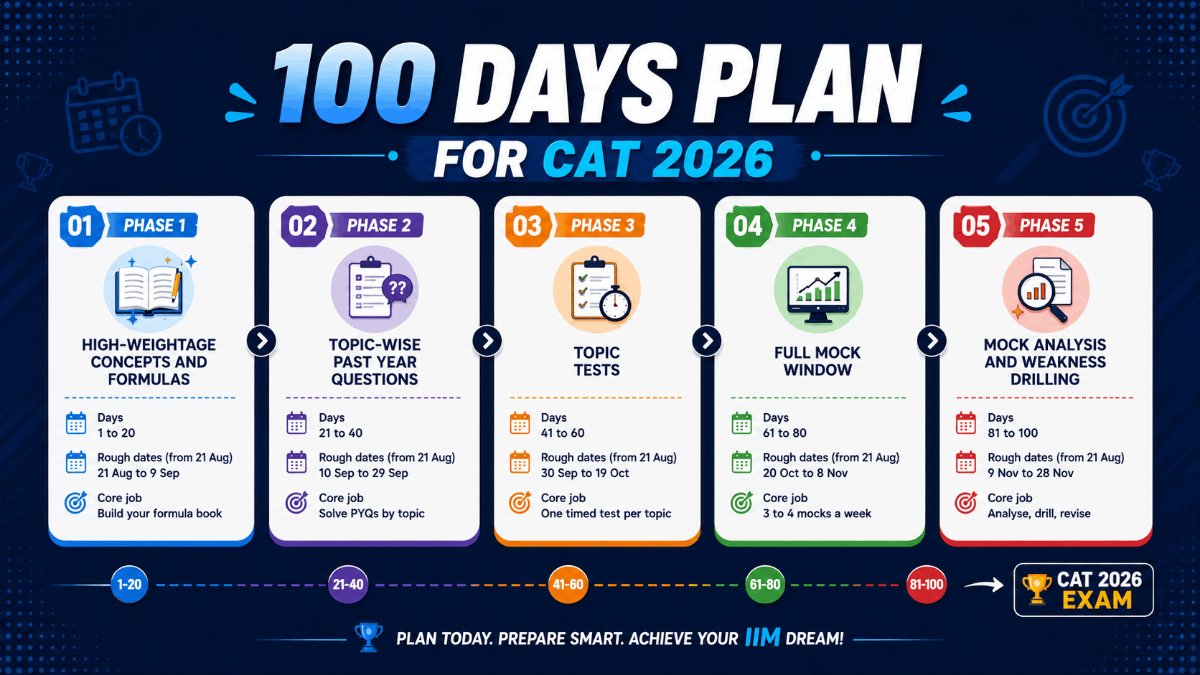
A hundred days is enough to move your percentile a long way, if you spend each block on one job instead of a bit of everything every day. This plan splits the last 100 days before CAT 2026 into five phases of 20 days each. First you lock the high-weightage concepts and formulas. Then you solve past year questions topic by topic, take timed topic tests, move into a full mock window and finish with heavy mock analysis and weakness drilling.
 Preparing for CAT 2026? Solve 1000+ Free Questions on Percentyl
CAT 2026 is on Sunday 29 November. Count back 100 days and you land near 21 August, so the second half of August is the window this plan is built for. The order below is one sensible sequence. If your basics are already strong, start mocks earlier and use the early phases for revision.
The 100-Day Plan at a Glance
Phase | Days | Rough dates (from 21 Aug) | Focus | Core job |
|---|---|---|---|---|
Phase 1 | 1 to 20 | 21 Aug to 9 Sep | High-weightage concepts and formulas | Build your formula book |
Phase 2 | 21 to 40 | 10 Sep to 29 Sep | Topic-wise past year questions | Solve PYQs by topic |
Phase 3 | 41 to 60 | 30 Sep to 19 Oct | Topic tests | One timed test per topic |
Phase 4 | 61 to 80 | 20 Oct to 8 Nov | Full mock window | 3 to 4 mocks a week |
Phase 5 | 81 to 100 | 9 Nov to 28 Nov | Mock analysis and weakness drilling | Analyse, drill, revise |
Phase 1 (Days 1 to 20): Lock the High-Weightage Concepts and Formulas
Spend the first 20 days getting fluent with the topics CAT tests the most, not the ones you enjoy the most. A formula you can recall in two seconds is worth more than one you can derive in two minutes.
The numbers make the priority obvious. Across the last five CAT papers, across all 3 slots, Quant is ruled by two areas: Arithmetic with 125 questions and Algebra with 109. Together they are over two-thirds of every Quant section, so your formula book begins there.
Quant area | Questions in last 5 CATs, all slots combined | Formula priority |
|---|---|---|
Arithmetic | 125 | Master every chapter |
Algebra | 109 | Master every chapter |
Geometry and Mensuration | 47 | Learn all the formulas |
Number Systems | 27 | Rules and shortcuts |
Modern Maths | 16 | Cover selectively |
The single biggest chapters to nail first are:
- Equations and Polynomials (34 questions in five years)
- Progressions and Series (28)
- Ratio and Proportion (22)
- Logarithms and Exponents (20)
- Averages (19)
- Time, Speed and Distance (18)
- Profit & Loss (17)
- Time & Work (15)
DILR has fewer formulas, but the same logic holds. The set types that show up most are:
- Analytical Reasoning (16 sets in five years)
- Logic-based Data Interpretation (14)
- Bar and Line charts (9)
So get familiar with how those are framed. VARC has no formulas at all. Read one hard non-fiction piece a day and learn the four Verbal Ability question types: Para Summary, Para Jumbles, Para Completion and Odd One Out. Para Summary alone appeared 39 times in five years, with Para Jumbles close behind at 30.
One last thing. Take a single full mock on day 1, before you study anything. A cold score tells you which section is your real weakness. On day 100, you will see how far you have moved. You need to start taking mocks from Phase 1 itself but the focus will not be on optimising the score. It will be to get used to the pattern from Day 1.
Phase 2 (Days 21 to 40): Solve Past Year Questions, Topic by Topic
Now put those formulas to work on the real thing: actual CAT questions, grouped by topic.
The CAT 2026 syllabus was built from 25 years of solved papers, so working through past questions topic by topic shows how CAT bends a concept into a question. Go in weightage order, highest first, so your hours follow the marks. And keep an error log from day one: every question you get wrong or solve too slowly goes in it, tagged by topic. That log becomes your weakness map for Phase 5.
Days | Section focus | Daily target |
|---|---|---|
21 to 27 | Quant: Arithmetic and Algebra PYQs | 45-50 questions |
28 to 34 | DILR sets plus Quant Geometry and Number Systems | 3-4 sets and 20-30 questions |
35 to 40 | VARC: RC passages and all four VA types | 3 RC passages and 20 VA questions |
Do not check the answer key after every question. Solve a full topic set, then review it in one sitting, so you see your patterns instead of one-off mistakes.
Phase 3 (Days 41 to 60): Topic Tests for Speed and Accuracy
Once you can solve a topic, the next job is solving it fast and under pressure. That is what topic tests are for.
A topic test is a short timed set on one topic, say 10 questions of Time and Work in 20 minutes. Knowing the method is not enough in CAT. You need it to surface inside 90-120 seconds. Topic tests build that speed while your accuracy is still fresh from Phase 2. Set a bar before you move on: if you are not hitting about 85 percent on a topic test, that topic goes back into practice.
Days | Test type | Per week | Time each |
|---|---|---|---|
41 to 47 | Quant topic tests (Arithmetic, Algebra) | 5 | 20-25 min |
48 to 54 | DILR set drills and VARC RC tests | 5 | 20-25 min |
55 to 60 | Mixed sectional tests, all three sections | 6 | 40 min |
By the end of Phase 3 you have hit every high-weightage topic three ways: formulas, past questions and timed tests. You are ready for full mocks.
Phase 4 (Days 61 to 80): The Full Mock Window
This is where you stop practising topics and start practising the exam. Full mocks, taken like the real thing will get intensified. Till now you may have been taking 1-2 mocks a week. But from hereon, the drill to take 3-4 mocks a week will start.
A CAT mock runs 2 hours, three sections in a fixed order (VARC, then DILR, then QA), 40 minutes each with no going back. CAT 2026 has 68 questions in all. Take every mock at your real slot time, in one sitting, so your body learns the rhythm. Then ramp up as your stamina holds.
Days | Full mocks a week | Sectionals a week | What you are fixing |
|---|---|---|---|
61 to 67 | 2 | 3 | Stamina and a first strategy |
68 to 74 | 3 | 2 | Section order and time splits |
75 to 80 | 3 to 4 | 1 | Exam-day rhythm and nerves |
The point is not the score. It is your strategy: which section order trips you, when you panic and which questions to leave alone. Always analyse a mock before the next one. An un-analysed mock is just a tiring afternoon.
Phase 5 (Days 81 to 100): Mock Analysis and Weakness Drilling
The last 20 days are won in analysis, not in new mocks. This is where most of the jump happens.
Keep taking mocks, but spend more time reading them than taking them. For every mock, sort each question into four buckets: solved correctly, got wrong, skipped but doable, attempted but should have skipped. The last two buckets are where your marks are hiding. Take the wrong and the skipped-but-doable questions, find the topic behind each and drill it with the PYQs and topic tests from Phases 2 and 3. Your Phase 2 error log points you straight there.
Days | Mocks a week | Analysis per mock | Main job |
|---|---|---|---|
81 to 87 | 3 | 2 to 3 hours | Deep analysis, build the weakness list |
88 to 94 | 3 | 2 hours | Drill weak topics, then re-test them |
95 to 100 | 2 | 1 to 2 hours | Light mocks, revise formulas, taper |
In the last three or four days, stop everything new. Revise your formula book, take one easy mock to stay warm, sleep properly and walk in rested. On 29 November the hard work is already done. You are just there to collect it.
Frequently Asked Questions
Is 100 days enough to crack CAT 2026?
Yes, if you use it well and your basics are not at zero. A hundred focused days, spent one job at a time, is enough to reach a strong percentile. What fails is 100 days of doing a little of everything with no plan.
What if I only have 60 or 70 days left?
Compress the first three phases. Give about 10 days to high-weightage formulas, 10 to topic-wise PYQs and jump into the mock and analysis phases, which matter most. Protect the mock window whatever else you cut.
How many full mocks should I take in total?
Across Phases 4 and 5 you will take roughly 15 to 20 full mocks. The exact count matters less than analysing every one before the next.
Should I use paid coaching mocks or free ones?
Use a recognised national mock series with a large test-taker pool, so your percentile reading is realistic. Free mocks are fine for extra topic practice. Percentyl has free CAT mocks and topic-wise practice you can fold into any phase.
Which phase matters the most?
Phase 5. Most aspirants take plenty of mocks but never analyse them properly, so they carry the same mistakes into November. The people who jump percentiles are the ones who treat analysis as the main event.